Showing posts with label Venetucci Farm. Show all posts

Monday, October 31, 2011

Discover "long" pie pumpkins


We're in that transitional time when the golden days of fall can suddenly give way to a burst of winter. I like to think of it as squash-stuffing season. In the last few weeks, I've made everything from zucchini boats (with the last of the summer squash) to, finally, one of my favorites, pumpkin-stuffed-with-everything-good (the well-deserved topic of a previous post.)

When stuffing a pumpkin, the hardest part is cleaning out the cavity at the beginning. In fact, I can't help comparing it to butchering a chicken! You have to continually reach into the slimy insides and pull out all of those slick but tough inner fibers to do it. Still, the effort is worth it. While many cooks will tell you canned pumpkin actually has the ideal texture for breads, pies and soups (and I would agree) a fresh pumpkin is the perfect vessel for cooking a savory stuffing and scraping the baked flesh from the hot shell is the best way to appreciate it in all of its culinary glory.


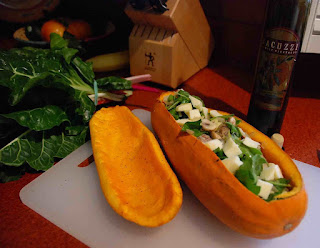
For the last couple of years, we've been the beneficiary of "long pie pumpkins" from Venetucci Farm, an heirloom variety first grown on the East Coast. It struck me this fall that at least two of my gardener-friends hadn't seen them before and observed them with fascination. Is it time for more people to discover this special secret ingredient? How fortunate we are that small farms grow so many wonderful varieties of produce and introduce us to little-known treasures like these! Resembling an oversized zucchini, these oblong pumpkins have an odd shape but are filled with tender meat. 

Most importantly, they are perfect for stuffing! By carving an opening lengthwise across the top, which can be lifted off and put back in place once the cavity is filled, it is easier to get inside and clean them and also to stuff them with wonderful fall food combinations. (See photo above.) For a recent version, I substituted fresh mushrooms for chunks of bread and added some greens: Swiss chard plucked from a backyard garden covered by the season's first snow.  Along with the hot breakfast sausage links from Doug and Kim Wiley's Larga Vista Ranch (my favorite sausage in the world), chunks of cheese, onion, sage and parsley, it was simple, quick to assemble, and... magnificent!

Wednesday, December 22, 2010

Redeeming one of the season's favorites: the potato


As a journalist, I sometimes come across stories that almost seem to write themselves.

That's how I felt when I heard about Chris Voigt, the executive director of the Washington Potato Commission, and his successful attempt to eat nothing but potatoes for 60 days. For Thanksgiving, he actually celebrated with a mound of potatoes, molded into the shape of a turkey, because he was determined to make a statement about how healthy potatoes really are.

He has an interesting theory as to why his stunt diet led to hundreds of media requests from all over the world. (I interviewed him shortly after he returned to his office after appearing with Matt Lauer on NBC's The Today Show.) He believes people like potatoes so much that they enjoy seeing them vindicated.

With all the sugar and salt-laden foods out there, and the popularity of carbs made by extruding paste through a machine (as is the case with most pasta) I share the view that the lowly potato seems to get unfairly picked on. After all, it is produced by a plant that grows in the earth, and there's no mistaking it's earthiness.

In one of my favorite nutrition books of recent years, The Jungle Effect: A Doctor Discovers the Healthiest Diets from Around the World — Why they Work and How to Bring Them Home, Daphne Miller devotes a chapter to the Icelandic diet, which is high in potatoes but results in a population with exceptionally low rates of depression. She draws an interesting connection between the sensory pleasure associated with consuming a food and the creation of mood-enhancing hormones that act like an antidepressant. She also offers several helpful tips for making the consumption of potatoes as healthy as possible. Start by choosing the smaller waxy-textured versions rather than the big conventional baking potato. (Local farms like Venetucci grew some fabulous multicolored spuds this past year.) Pre-cooking and then cooling them before eating, as is the case in making a potato salad, lowers their glycemic index considerably. Eating them whole (and with the skin) rather than mashed also yields benefits. And finally, adding a touch of vinegar also appears to have positive health attributes.

One revealing aspect of Chris' "diet" was that he had to eat 20 potatoes a day just to try to maintain his weight. While potatoes are filling (so filling it's hard to imagine eating 20 of them) they are actually relatively low in calories at 110 per average sized vegetable. Yes, it's easy to exceed this by heaping on the toppings, like cheese and butter. Still, Chris found it difficult to maintain his weight and actually lost 21 pounds over the 60 days.

An obvious alternative — that yields similar eating pleasure — is the sweet potato. According to 50 Secrets of the World's Longest Living People by Sally Beare, sweet potatoes are one of the most nutrient-packed vegetables you can find. They offer a similar smooth and hearty consistency to a potato with less carbohydrate and even more nutrients, including the beta carotene that gives them their cheery orange color.

With Christmas only hours away, I'm thinking about how potatoes are an affordable indulgence. Since Colorado is one of the largest producers, you can always get them locally grown. Mashed potatoes seem practically inevitable next to an equally decadent slice of meltingly tender Callicrate Beef prime rib. And how many Christmas Eve traditions involve a hearty ethnic soup (such as a creamy clam chowder) enhanced by the presence of potatoes?

Here's to enjoying all the blessings of the holiday season... and refusing to condemn potatoes, eggs, red meat, real butter, whipped cream and the other various villains out there that in fact have plenty of redeeming qualities and have fed humans well for centuries.

Wednesday, November 24, 2010

Thank a farmer

“The disconnect between the accelerating pace of life and our natural human roots is making our hunger for tradition and a simpler life ever greater. When we garden rather than buy from the grocery store, when we intentionally buy from people who have chosen a rough-hewn life in order to produce something truly good, we are saying, whether we realize it or not, that we are craving something. There is a natural human instinct to be in touch with our roots, to use our hands, to create things. And regardless of the ever-widening gap between modern life and the natural world, it is nearly impossible to eliminate that instinct.”  Foodie blogger and traveler Georgia Pellegrini in the introduction to Food Heroes: 16 Culinary Artisans Preserving Tradition

As a holiday with food at its center, Thanksgiving is a good candidate for thank-a-farmer day. We could all probably make our own list of favorite farmers, food artisans and culinarians as a fun and thoughtful exercise. (That's Patrick Hamilton from Venetucci Farm, above.)

It just so happens that Thanksgiving caps off National Farm-City Week, which has been celebrated since 1955 with the intention of building “interdependence between rural and urban citizens.” In our modern world, farmers and consumers need each other but also tend to stay in different camps. To be human is, by necessity, to be consumers of a sort and also simultaneously producers of another sort. So were we all better off in prior decades when the farmer and the consumer were one and the same? Or is better now that a few farmers can choose to farm wholeheartedly, while the majority of others apply themselves toward other pursuits, with a monetary exchange to mediate between all of these various specialized efforts?

It’s hard to arrive at a firm answer, except to say there are always trade-offs. And to suggest that our society has likely swung too far from its agrarian roots on this particular pendulum. Unfortunately, many more people would like to farm than can make it financially viable. (Same with writing and other intrinsically rewarding creative pursuits.) Thus we have people who grow their own food and read about food growing and keep their hands in it in small ways… engaged, avid consumers. And if they work hard at it, they can become models of self-reliance, the old tried-and-true formula of the farmer and consumer wrapped up into one.

All of us can be thankful for those areas in our life, those windows of opportunity, that do allow for simplicity, quiet thoughtful engagement and peace of mind and heart. We can deliberately touch our roots, use our hands, create things — and celebrate others who do — while hopefully working to make the world a place where people have the opportunity to do personally meaningful and rewarding work, where quality of life is recognized and valued by society as a whole. 

Saturday, November 20, 2010

Eat, Drink, Cook: Pumpkin Stuffed With Everything Good

From the first moment I stumbled across the recipe for Pumpkin Stuffed With Everything Good, I had to try it. I already had the perfect candidate: a beautiful little pie pumpkin I picked right from the vine at Venetucci Farm that I've been saving for something special.

One of the many things I love about Hethyr Pletsch, the personal chef who put on a holiday cooking class last weekend at Ranch Foods Direct, is her enthusiasm for ingredient substitution and experimentation. This is also true of Michele Mukatis, who taught a series of cooking classes this summer through her business Cultivate Health, and it's probably true of all foodies: part of the art of cooking is constantly improvising.
 

When I finally had a chance to try this recipe (an easily revisable mixture of meat, cheese, fruit and nuts roasted inside a pumpkin) I was improvising from the first. In the waning days of the farmers market when winter squash were plentiful, Smith Farms had an abundance of acorns in a glorious range of shapes and sizes. I chose one resembling a small pumpkin, thinking it would be great as a table decoration and then later for cooking. Over the weeks since, it even started turning orange. (Maybe the plant actually cross-pollinated with a pumpkin.) Anyway, it looked like it needed to be used up faster than the pumpkin, and it also had this perfect little stem on the top for a handle.


The results were beautiful and delicious. I had my moment of doubt first cutting into the squash (it's not easy to cut out the trap door on top and clean out the insides, but it is doable.) It also didn't take much more than an hour to bake (due to the fairly small size.) The spicy Italian sausage links from Ranch Foods Direct and the red wax-rind creamy melty Gouda cheese I used were excellent in it. (I didn't use bacon like the original recipe suggested, though I could have mixed it in. The sausage did seem to be a good choice.) I was reluctant at first to use bread in mine, so I included quartered fresh mushrooms as a filler. (Okay, I just happened to have day-old bread, so I did go ahead and use some of that too.) You could experiment with rice or a risotto pasta (I'm thinking about trying shredded cabbage) or go more in the direction of sweet (think dessert material) rather than savory (spectacular main dish.) But our savory version, with snipped fresh rosemary sprinkled in, was divine, a fun and flavorful one-dish meal (dish provided by nature).

After the two of us had dinner, we still had enough flesh left on the insides of the squash to scrape out and use later for a variation of curried pumpkin chicken chowder (a recipe from Hethyr Pletsch.)

At this time of year, a time for stuffing turkeys, I have to say it's almost as dramatic and satisfying to stuff a pumpkin to put in the middle of the table. And certainly, a possibility is to do both! Pumpkin Stuffed With Everything Good is as wonderful as it sounds.


Tuesday, November 9, 2010

Agriculture and culture

There's linguistic beauty in the way the word agriculture wraps around "culture" at its core.

Ethnic foods are particularly good at illustrating the connection. Attending a Mennonite Relief Sale recently, I was surrounded by crowds enjoying the chance to eat rare traditional foods and interact within a unique sub-culture. Words of greeting at such an event run along the lines of “Are you Marvin Neufeld’s son? I’m Paul Penner’s sister…” followed by standard farmer talk such as “Are you dry out your way?” rapidly devolving into a subtle contest over who is drier. (“We did get two inches back in September, but it’s all gone now…” “Well, we’re still waiting on our two inches.”) As the daughter of a Mennonite-raised farmer, I already know it is always too dry or too wet, too hot or too cold, on every farm.


Traditional German Mennonite food is stout, starchy and somewhat bland. The pre-eminent challenge traditionally wasn’t the aesthetics of looking sleek but surviving with enough energy left over to do hard physical work. Meat and potatoes, sausage and bratwurst, verenikas blanketed in white cream gravy (pan-fried pockets of dough stuffed with dried cottage cheese) New Year’s cookies (fried donut-like dumplings) and tart cherry mousse (a pudding made with flour, cream and sugar) are common iterations. One of the healthier dishes is the homemade sauerkraut; cabbage was often the closest my ancestors came to getting their greens. The dietary world has changed, obviously, but these are foods flavored by memories, passed on as a cherished inheritance.


(A note about the German sausage: it makes a great partner with the big gorgeous head of cabbage from Marcy Nameth and the boys at Greenhorn Acres. Add in a little diced Applewood smoked bacon, chopped red onion, cherry tomatoes — is there anything on earth better than a cherry tomato? — chunked up baked winter squash, grated cheddar and rosemary... maybe my new favorite herb, in part because it thrives in winter. I’ve also turned some of the cabbage into a simple slaw for making fish tacos with flaky chunks of halibut from Ranch Foods Direct topped with chile-flecked peach chutney, an ode to our wonderfully long Indian summer.)

Memories make food taste special: I went on a quest this fall to find a Hubbard squash for my mom, who fondly remembers my grandmother growing and baking them on their farm in North Dakota. In recent weeks, I lugged around the big oblong blue-tinged gourd the size of a turkey before finally delivering it to mom's kitchen. (Susan Gordon at Venetucci Farm warned me not to leave it outside or in my car where it might freeze.) A home gardener, cook and canner (also the product of a Mennonite upbringing), mom recently invited me to a saved seed exchange in her rural community featuring a woman who has managed to preserve ancient strains of native purple corn and calico-colored beans. The theme of food as connected to a culture, as a window on the past that might help us make a better future, seems to spring up everywhere.


I have to wonder if the amount of interest in Ranch Foods Direct's recent small-scale slaughtering demonstration, hosted by Venetucci Farm, is another example of the hunger people have to connect food with a context, with people they can meet and talk to, with work that they can understand and participate in and even learn to do themselves. As the great animal welfare pioneer Temple Grandin says of her recent book and movie promotion tours, people are genuinely curious and interested in how food gets from the farm to the table. One basic lesson of seeing a 1,000 lb. animal slaughtered is to understand the enormity of the undertaking, that the lives that keep us fed can't be taken for granted.


Then there's Emma Piper-Burket, a filmmaker I heard about recently who is making the connection between food and culture by asking important questions about what is happening in Iraq, birthplace of the world’s wheat. Why is the original breadbasket now forced to import grain? Her Iraqi Seed Project explores threats common to every agrarian-based economy, explains why so many food and agricultural traditions are becoming a rare treat, rather than a vital part of the fabric, in modern culture.