Thursday, July 14, 2011

July 15: Anniversary party at Trivelli's


Steve and John Trivelli originally planned to keep Trivelli's 35th anniversary low-key. But their mother, Barbara, was having none of it. The timing also happens to coincide with the passing of family patriarch, John Sr., in 2005. "She wanted to make it a memorial," Steve says, adding that when Italians do something, they typically do it big. "At Trivelli's, we like to party; we like to have fun!"
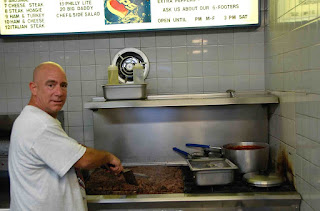
 

The tiny sub-shop - famous locally for its Philly cheese steak-style sandwiches - will have special festivities from 11 to 2 p.m. Friday, July 15, showcasing neighborhood businesses (including Ranch Foods Direct) grilling burgers and hot dogs, and offering hoagie specials throughout the day. John Jr., who plans to leave the shop in August to focus on marketing a line of children's books, will be signing copies of his delightful Wanna Bee series, which playfully introduces kids to various professions.


Trivelli's, still holding down the fort at the original 2927 N. Nevada, is a local institution. "We belong in an institution, that's for sure," Steve quips. Back in August 2005, Ranch Foods Direct ran an article on the family business in the newsletter to honor John Sr's passing. Since that time, brother Tony has left the former sub-and-pizza shop at Barnes and Austin Bluffs and moved to Florida. Steve says his mom (whom he calls "4-foot-8-inches of dynamite") is still "ornery as all get out" and, at 74, only just retired from working at the shop three months ago to do more traveling. She's planning to be at the store on the 15th to enjoy the celebration. (Steve and John also have two sisters, Barbie and Lynn, who both live in Mississippi.)


Steve admits the restaurant business is tough but says things have never been better at Trivelli's, which is seeing double digit growth in traffic every month. "We've done more advertising and direct mailing," he says. "But what's going on at a deeper level is that people are sick of the $5 sandwiches at Subway. Their meats and cheeses are the bottom of the line, and people are getting their fill of it." A 6-inch hoagie at Trivelli's is $5, bringing the price of the full meal deal to just under $8. The monster 12-incher goes for $10. "The value's there," Steve says. "There's no question about that."


One of the big selling points at Trivelli's is, of course, the tender beef from nearby Ranch Foods Direct. "I've got to buy good food; otherwise, I'll be a Subway," Steve says. "Our name is on the building. It means something to me. Everybody knows Trivelli's."


Roughly 200 customers a day rotate through the closet-size space, which also features a handy drive-through window, open Monday through Friday 10-8 p.m. and Saturdays 10-5 p.m.


Come by their celebration and show them some love on Friday, July 15!

Read a recent review from the Dine and Dash feature in the CS Indy. 

Tuesday, May 17, 2011

Regs holding back food entrepreneurship

Last month, Ranch Foods Direct received an official USDA grant of inspection authorizing on-farm use of a mobile meat processing unit now parked at Callicrate Cattle Co. Considering that the entire processing of each animal will be carefully observed by a USDA meat inspector —  who isn't busy trying to watch hundreds of animals coming off of a processing line literally every minute as he or she would in a large plant — you might think the authorization process was a breeze. It wasn't. It took nearly a year after the prototype was completed to obtain the certification while planners doggedly wrote and rewrote an extensive HACCP food safety plan. Fortunately, a nonprofit group called the Nebraska Environmental Action Coalition took the lead, committing untold resources and vigorously pushing the mobile processing concept in an attempt to benefit rural economies and increase small scale processing options. Their assistance made it possible for Callicrate Cattle Co. to host one of the first affordable working trailers in the nation.

I thought of all this at lunch this weekend, after someone alerted me to a news story about an unusual taco stand in California that is no longer able to sell a traditional Mexican specialty item, due to a clamp-down by the food police. The main ingredient in the grasshopper tacos —imported Oaxacan grasshoppers — were not "FDA approved." But officials agree there are no FDA approved sources for making this surprisingly popular dish. (Same story on the cicadas that made it into a top-selling batch of ice cream in Missouri.) There's also no indication anyone was ever sickened by either product.

Meanwhile, in Europe, one of the most dangerous e-coli outbreaks in history was attributed to officially certified organic bean sprouts.
 
It's obvious that regulatory hurdles are a threat to food entrepreneurship while falling short of insuring all approved foods are truly safe. A "cottage foods" designation is one form of protest, as is the push for "food sovereignty" occurring in a few communities willing to bet their economic futures on the production of healthy, local foods. Most observers would likely agree that the food police have somehow managed to go too far at the same time they have not gone far enough in the ways that really count.
  

Sunday, May 1, 2011

New offensive strategy: Grow okra


Sweet revenge for all those who believe academic programs are too focused on athletics: A small college in Dallas has transformed its "hallowed field" into hallowed ground of a different type, one capable of helping to feed the surrounding community. The gridiron has given way to a garden between the goalposts. Their new mascot? The "fighting okra," according to a delightful article by Mark Wynne, a food activist, writer and author of Closing the Food Gap. (For more about him, visit www.markwinne.com.

Read his article atfoodfreedom.wordpress.com/2011/04/02/texas-college-converts-football-field-into-organic-farm)

Some of the food the students now grow is served at Cowboys Stadium as well as at the city's restaurants, on campus and through nonprofit hunger programs. Eventually, they want to add an on-site store and a farmers market. These attributes are being used as broader learning tools; the garden also anchors a class in "social entrepreneurship." The college president says the goal isn't to turn students into farmers but into problem-solvers, something a life in agriculture helped forge in our country's bedrock generations.

Apparently schools all over the country have been contacting Paul Quinn's mentor, Yale University, about starting similar programs, so this idea is like a thriving bed of strawberries, sending out loads of vigorous runners.

(Read the Associated Press story at www.chron.com/disp/story.mpl/ap/tx/7544934.html)

Thursday, April 14, 2011

Sugar: Not so sweet after all


Science writer Gary Taubes is back, this time with a piece about an insidious but plentiful dietary compound that in all likelihood is far more dangerous than fat and red meat: sugar. His recent article in the New York Times Magazine, "Is Sugar Toxic?" combs through the research to find out how much is too much. Americans, by the way, eat a lot.

His digging shows that if sugar is toxic, it is of the "chronic" versus "acute" form, which means that while humans can tolerate high sugar in a meal or two, it might blind them to the impact it has over thousands of meals (which actually transpires over a period of mere months.) His investigation also shows that diabetes and metabolic syndrome are very likely triggered by fat we can't see: fat that accumulates in the liver as it attempts to metabolize large amounts of sweetened food. There's even a potential link to many common cancers: elevated insulin and related hormones (needed to process sugar-laden diets) appear to feed and accelerate tumor growth.

As he has in the past, Taubes mentions the Inuit, who experienced vibrant health and virtually no diabetes or malignant cancers while eating traditional diets, comprised of copious amounts of fatty meat accompanied by virtually no fruits or vegetables. As their diets became more "Westernized," rates of diabetes and cancers shot up.

Perhaps most telling in his article: the researchers who study the connection between cancer and sugars (here we are talking about the added stuff, not what is naturally occurring in fruits and other foods) have tried to eliminate it from their own diets. They admit that to them sugar is "scary."


Taubes has been doing some remarkable research and following it up with bold, provocative writing. He's responsible for the monumental piece "What if It's All Been  a Big Fat Lie?" which was published by the New York Times back in 2002. It reopened the debate over whether meats and meat fats are really the culprits behind modern diseases. His contention: not likely.

Tuesday, April 12, 2011

Home kitchen entrepreneurship

“The City is planning to outlaw chicken slaughtering, which is currently not prohibited. The officials writing this law insist that it is currently prohibited and thus the change is not really a change, but when I ask them to tell me where it says this in the law they give me different answers, and never tell me where it states this… So it will be legal to hatch chicks and harbor chickens, but when they are too old to lay eggs or injured say with a broken beak and they cannot eat, you may not kill them. Neither may you slaughter one to eat it… A two-year old chicken is quite fine to eat and our grandparents looked for dinner in their backyards and this was fine.  At a time when hunger issues and food shortage issues are discussed everywhere, we will be required to waste this valuable food resource, usually organically grown. In this way Denver is different from the Soviet Union, where my wife (who grew up there) said no one would think of restricting the rights of the people to produce their own meat from a chicken.” 

— James Bertini, founder of Denver Urban Homesteading

Since they founded Denver Urban Homesteading over a year ago, Jim and Irina Bertini have been fighting the good food fight, which includes their initiative to "free the chickens" in the Denver metro so interested town folk can go back to raising (and slaughtering) their own poultry. They are not alone in their ongoing frustrations with food rules, going so far as to compare the quasi-political patchwork of often petty, ever-changing and unworkable food regulation on the federal, state and sometimes local levels to a food police state. Virtually all of the small farmers and food artisans I know list the daunting labyrinth of food regs as one of their biggest hurdles, though they mostly talk quietly about it among themselves.

Now a fascinating new opposition movement is going public in a big way. Rural communities in New England that have been cultivating local food economies in order to revitalize are pushing "food sovereignty" initiatives. They want federal and state food inspectors and onerous regulations out of their hair. As blogger Kimberly Hartke writes, it's necessary to clear the way for more "home kitchen entrepreneurship."


(For more, read the Sustainable Cities Collective article which begins:

"The town of Sedgwick, Maine, population 1,012 (according to the 2000 census), has become the first town in the United States to pass a Food Sovereignty ordinance.  In doing so, the town declared their right to produce and sell local foods of their choosing, without the oversight of State or federal regulation.  

What does this mean?  In the debate over raw milk, for example, the law opens the gate for consumer and producer to enter a purchasing agreement without interference from state or federal health regulators."

Or Bloomberg Business Week, which summarizes:

"Two small towns have passed ordinances that would make small-scale farmers exempt from state and federal regulations if they sell foods they process directly to consumers.")

It's clear that these communities — which are betting their futures on a revival of local food — want to simplify food business certification and oversight. It's already highly debatable whether it should be illegal for someone to make a coffee cake in their home kitchen and sell it at a community farmers market just down the block. How can we have "cottage producers" or "cottage businesses" without the cottage (by prohibiting its use and insisting instead on something called a commercial kitchen... now doesn't that sound appetizing?)

I recognize the value of professionalism, of elevating a talent to a commercial offering. But I also recognize there will always be risks associated with living and eating and that disease-causing organisms are a naturally occurring part of the environment. The question: are food safety rules realistic, decipherable and flexible enough or are they actually a trade barrier, making it difficult for small local food producers to compete even with imported items that travel halfway around the world from under-developed countries?

Should it put our mind at ease that big food manufacturing plants are occasionally inspected, along with the copious shipments of imported food and food ingredients? Or that these companies have complicated HACCP plans written by high-priced consultants and lawyers and overseen by bureaucrats? The regulations ought to be plain enough to both food producers and consumers that high priced middle men aren't required to spend hours interpreting, and then re-interpreting, them.

On that note, don't forget that tax filing deadline day is fast approaching.