Thursday, December 15, 2011

The ultimate "family restaurant"?

New York City restauranteur Massimo Galeano wanted to serve his customers the same traditional Italian dishes he grew up with and still craved. So he started bringing his mother from Bologna for weeks-long visits to handcraft the tortellini, ravioli, tagliatelle and other pastas he serves at Gradisca. At her flour-dusted table in clear view of diners, she rolls, shapes and stuffs the dough, conjuring a soothing presence that makes the meals feel truly home-style, in an age when the term "family restaurant" gets batted around a bit too lightly. Read the delightful story in the Dining Section of this week's New York Times.

And while there, here's another piece to enjoy: author Jennifer Steinhauer describes why we feel slighted with the frequent appearance of store-bought items at the neighborhood bake sale or pot luck. Her article vindicates my decision to make German Chocolate Brownie Bars at Halloween, even though I wasn't sure they'd appeal to trick-or-treating kids or protective parents. (By all appearances, they did, although the store-bought chocolate-dipped M&M granola bars ultimately proved most popular.)

In a world where so much of what we eat is conveniently mess-proof and cookie-cutter, it's nice to see that hand-made and one-of-a-kind can still hold its own. (And yes, even on those occasions when the pan of bar cookies is crispy brown on the edges while the center isn't completely done... and the harried cook scrambles for a remedy... kinda like the fourth quarter of a Broncos football game. Sigh.) 

Tuesday, December 13, 2011

Eat, Drink, Cook: The Potato Pancake Tradition

Over at Hungry Chicken Homestead — where blog writer Bonnie Simon says her citified chickens rule the roost — there's an opportunity to weigh in on the best way to make potato pancakes.

Bonnie is Jewish, and potato latkes are a traditional food for her family at this time of year, even if she and her mom trade friendly barbs over whether the potatoes should be blended or shredded first. (And don't we all know what those fun little food disputes can be like?)

Bonnie's story and recipe reminded me that my mom, who is not Jewish but rather of German Mennonite ancestry, often made potato pancakes for us when we were kids. (Hers were pillowy smooth rather than free-form shredded too. Maybe it's a generational thing.) Those tender pancakes were fragrant, warm and soft, perfect for cold winter mornings or long dark winter evenings on the farm. Comfort food, that's what they were. Bonnie's remembrances are feeding my own, and now I'm thinking about making some myself. Plus, group me with those who think potatoes have been unfairly demonized (Dr. Daphne Miller devotes an entire chapter to the healthy upside of traditional potato-centric diets in her wonderful book, The Jungle Effect: The Healthiest Diets from Around the World — Why They Work and How to Make Them Work for You.) My view: Fast food french fries, bad. Colorado potatoes with skins on, good. Especially during the winter.

For something leaner, lighter and literally greener, though, I couldn't help noticing a recipe from Gourmet (God rest its soul, my all-time favorite magazine before the clueless bean-counters parachuted into the Conde Nast corporate office and decided since Bon Appetit published recipes, too, the best literary food journalism available in print should be canned) for zucchini latkes. If you're like me, you find yourself craving all things green during these dark (but sparkly) days of plant dormancy. Here's a way to have your pancake, and eat something green too.

ZUCCHINI LATKES

MAKESABOUT 36 LATKES
  • ACTIVE TIME:45 MIN
  •  
  • START TO FINISH:1 1/4 HR
Add a little color to the Festival of Lights with zucchini pancakes that shine green. Lighter than potato latkes, they’re the Mediterranean cousins who’ve traveled north to visit family in eastern Europe.
  • 3 lb zucchini
  • 1 1/3 cups plain fine dry bread crumbs
  • 2 large eggs, lightly beaten
  • 1 teaspoon dried marjoram
  • About 1 cup vegetable oil for frying
  • ACCOMPANIMENT:

     
    sour cream
  • EQUIPMENT:

     
    a deep-fat thermometer
  • Grate zucchini using medium shredding disk of a food processor. Transfer to a bowl and toss with 2 tsp salt. Let stand 30 minutes.
  • Squeeze zucchini in batches in a kitchen towel to remove as much liquid as possible. Transfer zucchini to a large bowl and stir in bread crumbs, eggs, marjoram, 1/2 tsp salt, and 1/4 tsp pepper.
  • Preheat oven to 200°F.
  • Heat 1/3 cup oil in a 12-inch heavy skillet over medium heat until it shimmers. Scoop 2 Tbsp mixture per latke into skillet (6 to 8 per batch). Flatten with a fork to form 21/2- to 3-inch pancakes. Fry until golden brown, about 2 minutes per side (adding more oil as necessary). Transfer to a paper-towel-lined baking sheet and keep warm in oven.

Thursday, November 17, 2011

There's a new chef in town


Though Chef Kevin Campbell, above, has a degree in hotel and restaurant management from Colorado State University, he claims to be largely self-taught as a chef... and what a chef he is! His appreciation of the best quality ingredients and his deft creativity in the kitchen all spring from one basic inspiration: he loves to eat. He came from one of those classic Southern families where cooking and eating were celebrated among life's greatest pleasures.

Kevin hosted a dinner for the local Catamount Institute at Ranch Foods Direct that was delicious and seasonal from beginning to end, with some wonderful little surprises along the way. He served butternut acorn squash soup (with mushroom Jack cheese and truffle oil) in rustic canning jars to start. As a "nest" for his tender roasted vegetables, he created a bed of what he calls "dirt:" an earthy crunchy combo of dried mushrooms, whole wheat bread crumbs, sesame, hemp and flex seeds studded with broccoli sprouts and arugula. He infused the warm mashed potatoes with beef marrow. Another ingenious addition was the farm fresh egg, soft-boiled, battered and fried to resemble a hush-puppy. Cutting into it released the golden yoke, which was intended to gently cascade over the top of the sliced prime rib roast for his decadent version of steak-and-eggs. (Whoa!) The caramel toffee apple pie to end was a typical autumn classic that was anything but ordinary.


Wow, this young chef is amazing; he's one to watch. And another thing: he's nice! Mild-mannered, humble, polite: a rarity in this age of celebrities, pundits and out-sized egos.


Monday, October 31, 2011

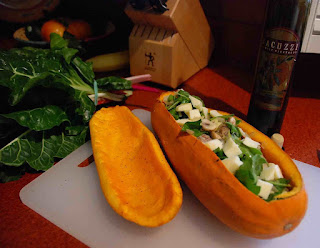
Discover "long" pie pumpkins


We're in that transitional time when the golden days of fall can suddenly give way to a burst of winter. I like to think of it as squash-stuffing season. In the last few weeks, I've made everything from zucchini boats (with the last of the summer squash) to, finally, one of my favorites, pumpkin-stuffed-with-everything-good (the well-deserved topic of a previous post.)

When stuffing a pumpkin, the hardest part is cleaning out the cavity at the beginning. In fact, I can't help comparing it to butchering a chicken! You have to continually reach into the slimy insides and pull out all of those slick but tough inner fibers to do it. Still, the effort is worth it. While many cooks will tell you canned pumpkin actually has the ideal texture for breads, pies and soups (and I would agree) a fresh pumpkin is the perfect vessel for cooking a savory stuffing and scraping the baked flesh from the hot shell is the best way to appreciate it in all of its culinary glory.


For the last couple of years, we've been the beneficiary of "long pie pumpkins" from Venetucci Farm, an heirloom variety first grown on the East Coast. It struck me this fall that at least two of my gardener-friends hadn't seen them before and observed them with fascination. Is it time for more people to discover this special secret ingredient? How fortunate we are that small farms grow so many wonderful varieties of produce and introduce us to little-known treasures like these! Resembling an oversized zucchini, these oblong pumpkins have an odd shape but are filled with tender meat. 

Most importantly, they are perfect for stuffing! By carving an opening lengthwise across the top, which can be lifted off and put back in place once the cavity is filled, it is easier to get inside and clean them and also to stuff them with wonderful fall food combinations. (See photo above.) For a recent version, I substituted fresh mushrooms for chunks of bread and added some greens: Swiss chard plucked from a backyard garden covered by the season's first snow.  Along with the hot breakfast sausage links from Doug and Kim Wiley's Larga Vista Ranch (my favorite sausage in the world), chunks of cheese, onion, sage and parsley, it was simple, quick to assemble, and... magnificent!

Monday, September 26, 2011

Signposts of the seasons

The years, even the seasons, seem to go by faster and faster. One of the joys of farm life is being constantly surrounded by signposts of the unfolding seasons. The calf shown above has been one of our yardsticks of time's passage. While most of the calves born at Callicrate Cattle Co. are black, the result of Angus and Wagyu breeding, the calf above appeared in the spring of 2010, and his unusual red-and-white hair coat quickly distinguished him. The odd blocks of colors are not something you can easily associate with any particular breed or bloodline typically seen at the ranch.

Last winter, while a light coat of frost was on the ground, I was looking at the weaned calves that had been gathered in the pen near the shed, and I immediately recognized this calf again, set off by his tell-tale pattern. He had left his momma and moved on to a new phase of life.
Today, that calf, along with the rest of his herd mates, is reaching full maturity. Like the rest of us, he and his friends are enjoying these golden fall days while they last. He's clearly well-fed and content, a gentle spirit. And so it is that we get to experience and steward this precious cycle of life. Farming has always been a profession that kept its practitioners grounded and humbled by nature's mystery and wonder.  We're not a predominantly agrarian culture anymore and that's unfortunate. Few things are as satisfying as watching and participating in the continual evolution and renewal of the natural world.